

For years, international anime fans held a persistent, stubborn bias against Chinese 3D animation. The standard critique was always the same: it looked too much like a stiff, unpolished video game cutscene. Early xianxia and xuanhuan adaptations often suffered from rigid character physics, weightless combat, and expressions that sat firmly in the uncanny valley.
But things have drastically changed.
The modern 3D donghua industry has undergone a massive visual effects revolution, completely shattering those old stigmas. Driven by bleeding-edge rendering engines like Unreal Engine 5 and elite motion-capture technology, current series are delivering action sequences that frequently outshine traditional, hand-drawn 2D anime. This isn’t just about one or two lucky hits; across the entire medium, Chinese animation studios are setting a brand-new standard for cinematic scale and fluid combat choreography.
How the 3D Donghua VFX Explosion is Defining Action Anime
1. Shattering the “Video Game Cutscene” Stigma
The rapid evolution of modern 3D animation techniques comes down to how studios are handling environmental texturing, fluid physics, and organic movement. In the past, 3D series felt artificial because everything was too clean. Today, top-tier production houses are intentionally layering in microscopic imperfections—dust motes caught in volumetric light beams, dynamic cloth and hair simulations that react to gravity, and complex facial rigging that allows characters to show subtle micro-expressions.
Furthermore, 3D pipelines grant directors total spatial freedom. In a traditional 2D fight scene, an unbroken tracking shot following a character flying through exploding terrain requires immense, exhausting human labor. In 3D, a virtual camera can dynamically spin, whip-pan, and warp perspective seamlessly around a cultivator mid-air, creating a relentless sense of speed and scale that is incredibly difficult to sustain on a weekly 2D broadcast schedule.
2. The Powerhouses Leading the 3D Revolution
Look across the current streaming charts, and you’ll find a massive wave of series proving that 3D is the new peak for high-stakes fantasy action.

- Renegade Immortal (Xian Ni): Produced by Build Dream Studio, this series has gone completely viral on social media for its sheer kinetic violence. The combat balances supernatural lightning and spiritual spells with immense physical weight, making every clash feel genuinely dangerous.
- Slay the Gods (Zhan Shen): Sparkly Key Animation has pushed boundaries by mixing contemporary and mythological aesthetics. The visual effects representing divine power pathways and reality-warping domains are a masterclass in abstract particle physics.
- Coiling Dragon (Pan Long): The recent premiere from studio CG Year (Great Journey of Teenagers) has stunned viewers with its pristine atmospheric graphics, utilizing flawless global illumination to bring a rich, western-fantasy-inspired magic system to life.
- The Demon Hunter (Cang Yuan Tu): Famed for its highly stylized “ink-wash” martial arts choreography, this series proves 3D doesn’t have to look hyper-realistic—it can look like a living, moving piece of traditional Chinese art.
- Battle Through the Heavens (Dou Po Cangqiong): As a long-running juggernaut, its continuous evolution over the years acts as a literal timeline for the industry’s growth, culminating in some of the most iconic, high-octane faction wars ever animated.
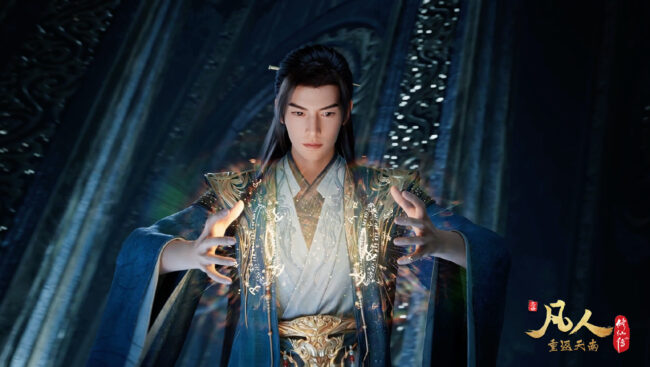
- A Record of a Mortal’s Journey to Immortality (Fanren Xiu Xian Chuan): Handled by Original Force, this series is universally praised as a pioneer in modern 3D donghua. Utilizing industry-leading motion capture and highly realistic character modeling, it treats its strategic, high-stakes cultivation encounters with unparalleled mechanical precision, proving how smooth and human 3D martial arts choreography can truly look.
- Tales of Herding Gods (Mu Shen Ji): Sparkly Key Animation has pushed its production values to a staggering level with this adaptation. The cinematic direction leans heavily into grand, surreal Buddhist and Daoist visual motifs, transforming abstract spiritual techniques into massive, reality-bending visual spectacles that leave audiences in awe.
3. The Balanced Verdict: Spectacle vs. Substance
While the visual effects explosion is an undeniable victory for the medium, the rapid shift toward massive, movie-level action sequences does come with an intrinsic hurdle that the industry is still learning to balance.
The Pacing Conundrum: Because these groundbreaking visuals thrive in high-energy combat, many 3D adaptations tend to favor a breakneck, action-heavy narrative pace. In the rush to deliver the next viral fight scene, the quieter, slow-burn world-building and intricate character-driven monologues that made the original web novels so beloved can sometimes get condensed into rushed exposition.
However, as pure spectacles of technological innovation and artistic evolution, these series prove that 3D donghua has firmly evolved past its awkward early years. It is no longer a substitute for traditional animation—it is a dominant, visually spectacular medium defining the future of action storytelling.
Do you think modern 3D donghua has officially surpassed traditional 2D when it comes to massive action spectacles? Which studio’s visual style is your absolute favorite right now? Let me know in the comments below!
Last Updated on June 7, 2026 by Yu Alexius
Leave a Reply
You must be logged in to post a comment.